


Taking a gap between high school and college can be a smart move for many athletes. You might use this time to train, compete, recover from an injury, or finalize your college plans. But here’s the catch: it can also affect your eligibility if you enter official events after the grace period has expired. Here’s how NCAA delayed enrollment works and how to protect your eligibility while you prepare for college.
What is NCAA Delayed Enrollment?
NCAA delayed enrollment happens when a student waits more than a year after high school to start college. The NCAA gives students one year to enroll (some sports allow even less time).
Waiting too long can cost athletes a year of eligibility and require them to sit out their first season. If you compete in organized events after your sport’s grace period, you can be charged a season of competition and may have to serve an academic year in residence when you get to campus.
The exact outcome depends on your division and sport, and the NCAA Eligibility Center reviews these cases depending on the Division you compete in.
Start with a plan: If you’re rehabbing or cross-training during a gap, you still control your recruiting momentum. Start with a plan and communicate with the coaches. For ideas, see NCSA’s guides on overcoming an injury during recruiting and recruiting myths.
Grace Period and Timing
After finishing high school, student-athletes get a short window of time they can use to compete. All competitions you participate in within this window will not trigger delayed-enrollment penalties.
But once the window ends, any organized competition you play before you enroll full-time is reviewed under the NCAA’s delayed-enrollment rules.
For Division I and II, this review runs through the NCAA Eligibility Center, while Division III handles everything on campus.
If you compete after your grace period and before you enroll full-time, you risk:
- A season of competition being charged for that 12-month period; and
- An academic year in residence (AYR), during which you may practice and receive aid but cannot compete.
What Counts as Organized Competition?
According to the NCAA, student-athletes are in organized competition when any one of the following is present: a published schedule, officials, results or standings, ticketed entry, set rosters or uniforms, or league/club administration.
Training with a team is not the same as competing.
When in doubt, treat it as organized competition, document it, and disclose it during the amateurism certification process. There are also rules that student-athletes should know about signing with a professional team, agents, individual payments and declaring for a draft that affect eligibility.
What is the NCAA Delayed Enrollment Rule?
Let’s picture this on a timeline. If your class graduates on June 1 and you start college in late August, any fall events that take place after your sport’s grace period can be reviewed and may be charged as a season.
The penalty for delaying enrollment and competing past the grace period is that an athlete may not compete their first year enrolled in college and the athlete loses one year of eligibility for every year he or she competed after the grace period. Here is an example:
Jane plays soccer in England. Jane graduates from high school in May 2026. Jane continues to play in organized competition in England and does not enroll in college.
- If Jane plays in a game between May 2026 and August 2027: no penalty.
- If Jane plays in one or more games between August 2027 and August 2028: risk sitting out one year, lose one season of eligibility.
- If Jane also plays in one or more games between August 2028 and August 2029: risk sitting out one year, lose two seasons of eligibility.
- If Jane also plays in one or more games between August 2029 and August 2030: risk sitting out one year, lose three seasons of eligibility.
- If Jane also plays in one or more games between August 2030 and August 2031: risk losing all seasons of eligibility.
Build your plan with our guide on NCAA Eligibility Requirements, then cross-check details in the NCAA’s Delayed Enrollment handout.
How the Rule Differs by Division
No matter the division, competing after your grace window and before you enroll can affect eligibility. The fine print lives in each division’s bylaws, so familiarize yourself with the rules below and always check with your college’s compliance office.
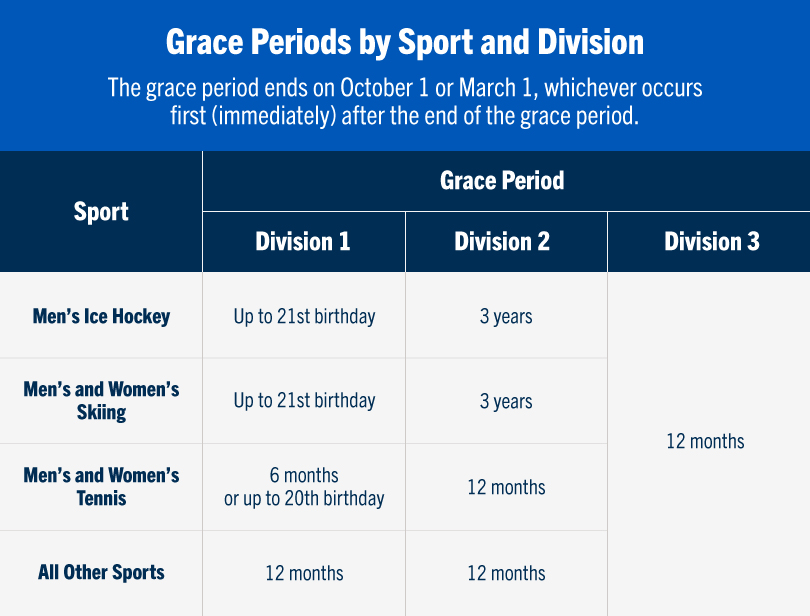
Division I (d1)
Most sports follow a grace window, yet a few use different timelines. If you play official events after the window and before enrolling full-time, you risk a season charged and, in some cases, a year in residence. The five-year clock starts at full-time enrollment. Be sure to confirm details with your school.
Division II (D2)
DII is a similar concept but applies its own bylaws. If you delay full-time enrollment beyond your grace period and compete in organized events, you can be charged one season for each 12-month period of participation, and AYR may apply. Keep in mind, DII uses a 10-semester/15-quarter window to complete seasons. Be sure to verify the rule with your future program.
Division III (D3)
DIII handles initial eligibility on campus. Competing after your window can still carry consequences, so make sure to confirm your dates and the applicable bylaw with your school.
NAIA / NJCAA
These are separate associations with their own manuals and timelines. So don’t assume NCAA rules apply. Check the NAIA Handbook and the NJCAA Handbook, or ask the compliance office at your future program for more details.
For the current Division I waiver guidance affecting 2025–26 eligibility, review the NCAA’s Waiver Eligibility Q&A.
How to Protect Your Eligibility During a Gap Year
- Set your anchor dates. Note your class graduation date and your first day of full-time enrollment. All analysis runs between those two points.
- Log each event. Keep a dated log of post-grad competitions and save links or emails that verify results or entry lists.
- Check for “organized” markers. Schedule, officials, posted results or standings, admission, set rosters or uniforms, or league/club oversight all signal organized competition.
- Finish your Eligibility Center tasks (D1/D2). Create or update your NCAA Eligibility Center account and complete amateurism questions.
- Confirm in writing. Email your future school’s compliance office with your dates and planned events and ask for the bylaw citation that applies to your sport.
- Keep an organized folder. Include your graduation date, planned enrollment date, event log, brackets/schedules/rosters, posted scores or organizer emails, acceptance/enrollment confirmations, and one-sentence context notes for unusual situations.
FAQS About Delayed Enrollment
Is practicing with a team okay if I don’t play in games?
Yes. Training isn’t the trigger. Certification looks at official competitions after your window. Add practice context in your disclosure.
I took part-time college classes before enrolling full-time. Does that change anything?
Your anchors are the class graduation date and your first full-time term. Note part-time work in your forms and confirm compliance.
I already played after my window. What should I do now?
Make a dated list of each event, save links or results, contact your future school’s compliance office, and submit everything to the Eligibility Center if you’re D1/D2-bound. Outcomes depend on volume and context.
Does delayed enrollment affect recruiting or scholarships?
It can. Coaches may adjust your start term, redshirt plan, or aid based on your dates and whether AYR applies. Share your timeline in writing and ask how it affects roster spot and scholarship timing.
Delayed Enrollment Doesn’t Have to Cost You a Season
Share your dates with coaches, confirm the rule with compliance, and keep proof of what you played, so certification goes quickly when you enroll.
Sorting out a gap year? Get a free recruiting assessment and map your timeline with an NCSA coach.